
Salt Lick
Let's Start At The Very Beginning

I am married to someone who believes salt is an unalienable right. When I owned the cooking store in Alexandria, VA, we stocked an impressive selection—so much so that we regularly special-ordered large quantities for certain restaurants. This Substack post should give you a better understanding of this Ur-seasoning.
Salt enhances flavors, but it also tamps down bitterness and creates a wonderful counterpoint to sweetness. In bread baking, it strengthens gluten while adding a pleasing depth of flavor. In short, it’s far more than just sodium chloride
A Little History
Salt is likely the oldest seasoning agent in human history. Beyond flavor, it has long been a preserving agent and a medicinal staple—used to relieve congestion, aid digestion, and soothe aches and pains. Our earliest records of salt production come from China around 3600 BCE. The words 'salad' and 'salary' are derived from the Latin 'sal,' as Roman soldiers were often partly paid in salt. And let’s not forget Venice—its early power was built, in part, on a monopoly of the salt trade.
Salt is obtained either by evaporating seawater or mining ancient underground deposits. If you’d like a particularly polished tour of salt mines, Salzburg, Austria, offers an experience beyond being home to Mozart and Red Bull.
In the New World, Indigenous tribes boiled down water from salt springs. In the early 1600s, when Dutch explorers (later brutal colonizers) first encountered the people of what is now St. Maarten, they found them producing salt from natural reserves. So valuable was this resource that Spain, the Netherlands, and France fought over it until St. Maarten was divided between the latter two in 1648. That division remains today, and the salt ponds are still in operation.
Mined Salt
Most of the salt we use in the U.S. is mined. The two most powerful players are Morton Salt Company, a subsidiary of Stone Canyon Industries, the largest salt producer in the world, and Diamond Crystal Salt, owned by Cargill, a monolith in our food supply chain.
Kosher salt—some say it should be called koshering salt—derives its name from its use in koshering or preserving meat and is not blessed by a rabbi. Its grain is larger and more irregular than table salt, so less is used to draw out blood from meat, and it is easily washed off after that process is finished. Scientists have measured that a spoon of kosher salt has less salt than the same spoonful of fine table salt. I found an interesting comparison between Diamond Crystal and Morton's versions of kosher salts in a blog: Handle The Heat.
According to the blog, Morton Kosher Salt is much denser and almost twice as salty by volume as Diamond Crystal. It's made by rolling cubic crystals of vacuum-evaporated salt into thin, dense flakes. Because it takes longer to dissolve and is almost twice as salty, it's easy to accidentally over-season your food or under-season because the salt crystals don't adhere to your food.
The author, Tessa Arias, cites a ratio from Cook's Illustrated: if a recipe is written with Diamond Crystal Kosher Salt and you're using Morton's version, decrease the volume by 25%. Conversely, if the recipe specifies Morton's kosher salt and you're using Diamond Crystal, increase the amount by 50%.
Even though both mined salts go through a brine process, Arias prefers the method used by Diamond Crystal and considers their kosher salt her go-to for cooking. It's made by crystallizing an open container of brine to produce light, hollow flakes that adhere to food wonderfully. It's also far less salty than Morton's, making it less likely you'll over-season your food.
The finer-grained table salt, made popular by the little girl with the umbrella, actually has some additional ingredients—an anti-caking agent to prevent solidification in humid weather (no need for raw rice in the shaker) and powdered iodine sifted into it. This addition was mandated in the 1920s to improve thyroid hormone production in the U.S. population when studies showed a rising incidence of simple goiter—a problem solved when a diet includes sufficient amounts of iodine-rich seafood and dairy.
Another mined salt that has captured the attention of every gourmet food catalog designer is Himalayan pink salt. Its color is derived from various forms of algae that have colored the salt over the millennia, and it's estimated this rose-colored salt can provide up to 84 different minerals. It comes from mines in Pakistan where an ancient seabed, formed millions of years ago, lay buried. Blocks of it are also sold so you can grill on them, imparting a salty taste to the food. However, there's not enough scientific data to prove it's a healthier salt than other versions.
Evaporated Salt
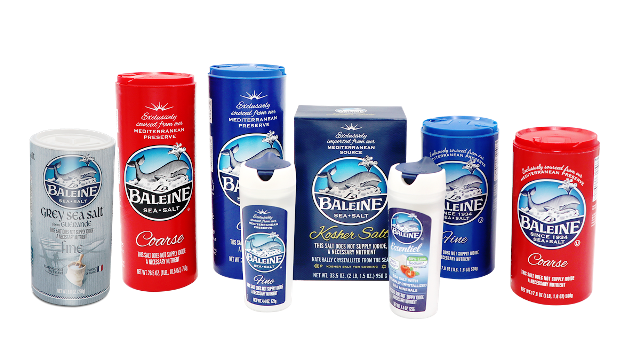
Subjectively speaking, I prefer using a sea salt for cooking than a mined salt. I have occasionally used Diamond Kosher Salt for making Robuchon's salt crusted beef and similar dishes with fish which are baked in the oven under a mound of salt but have certainly looked for other brands. I use La Baleine both in their fine and coarse crystals for general cooking. I like its taste and price range. Maldon and Fleur de Sel make great finishing salts - and Maldon itself has an interesting production story. This British company (pronounced without a French accent) has a different approach to evaporation and it produces a unique, pyramid shaped crystal. As England does not get the heat and wind benefits that Sicily and France do, they use a much different but ingenious technique. Sea water is pumped into salt pans and the resulting brine is carefully brought to the boiling point and then left to reduce for 16 hours. This very carefully regulated process produces the almost mathematically precise crystals you see in this photograph .
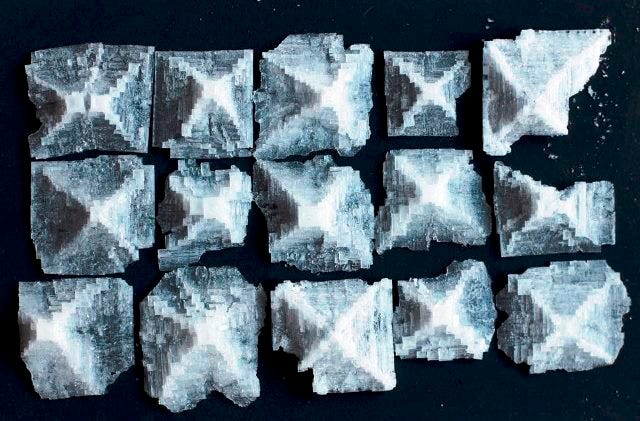
.
Solar evaporation is what you see in the salt beds of Trapani, Sicily, the Camargue and the Guerande in France. There are a series of deep and shallower ponds in which the slowly evaporating water is transferred until all that is left is the crystalized residue. In the Guerande, the salt is grayish in color from the choice of clay used to form the ponds. It does have a different taste than the salt created in Trapani or in the Camargue - which makes these salts from different areas so much fun to add to foods. Fleur de sel, which is a particular specialty of the Guerande salt flats, is now being produced in other salt flats. It is the very top layer of salt crystals that form when the sun and winds combine forces in a certain way. And it takes months for the crystals to dry out and be separated from impurities. This interesting video -admittedly long, but it has English subtitles - explains the subtleties of this most particular of salts.
The best supplier of salts in the US that we dealt with through a distributor was Saltworks in Washington State. You can purchase some of their salts in retail packaging or in bulk amounts, and they produce bath salts as well. Saltworks at one time produced a fleur de sel that was smoked on barrel staves of casks used to produce Chardonnay wine. It was the fastest selling aromatized salt we had in the store. I am in mourning that their version is no longer available. I even squirreled away a jar in the 109 boxes that are making their way to Bologna